

<meta name="google-adsense-account" content="ca-pub-5351193418738936">
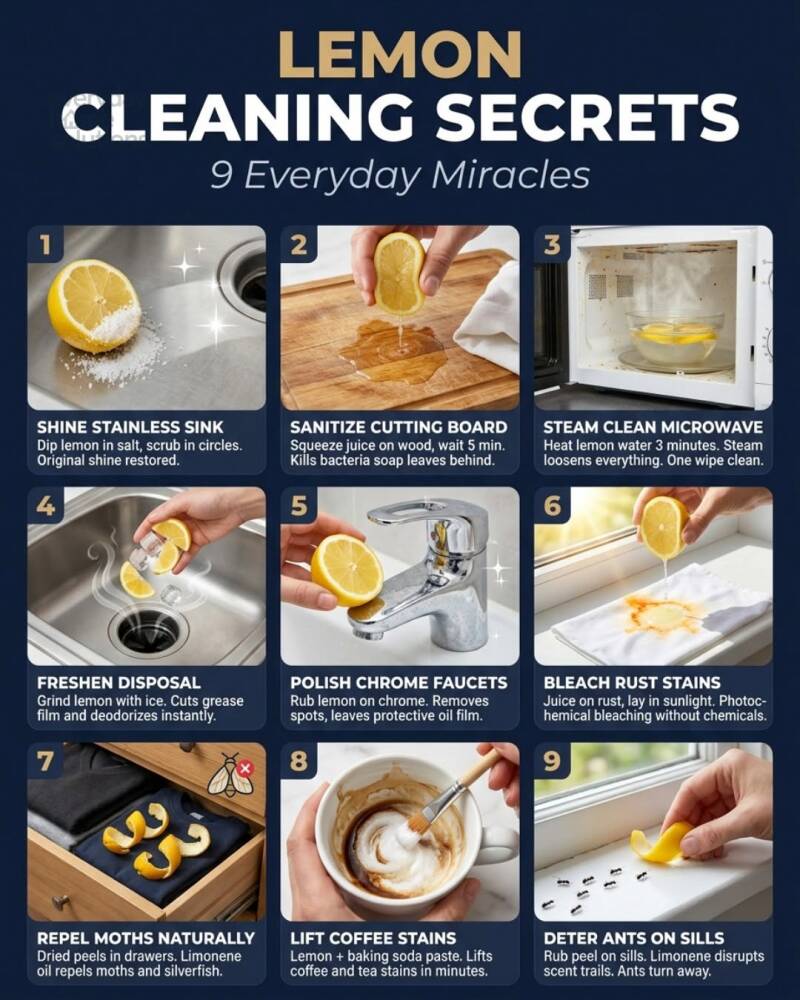
Most people squeeze lemons into water or onto fish and throw the rest away without realizing that every part of a lemon — the juice, the peel, the oil, and the acid — handles cleaning jobs that specialty products charge ten times more to do worse. Half a lemon dipped in coarse salt scrubs a stainless steel sink back to its original shine because citric acid dissolves mineral deposits while the salt provides a non-scratch abrasive. Lemon juice squeezed onto a wooden cutting board and left for five minutes sanitizes the surface and pulls odors out of the wood grain that soap leaves embedded. A bowl of water with lemon slices microwaved for three minutes fills the interior with citric acid steam that loosens every splatter so it wipes off in one pass. Lemon peel ground in the garbage disposal with ice cubes cuts through grease film on the grinding teeth and leaves a clean citrus scent behind. Lemon juice rubbed on a chrome faucet removes water spots and leaves a protective citrus oil film that prevents new spots from forming. A lemon half rubbed across a rust stain on white fabric and laid in direct sunlight bleaches the iron oxide out through a photochemical reaction. Dried lemon peels placed in drawers and closets repel moths and silverfish naturally through the limonene oil they release. Lemon juice mixed with baking soda into a paste lifts coffee and tea stains from mugs and countertops in minutes. A lemon peel rubbed along a window sill deters ants because limonene disrupts their scent trail navigation. One lemon covers the kitchen, the bathroom, and the closet.